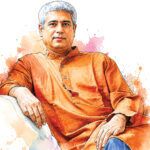
Why theatre? Is there any particular reason that you chose this form to be your creative expression?
Mahesh: No particular logical explanation. It's an art form. I chose this form of art because it appeals to me I guess and it kept appealing to me through my entire career. Since I was twelve, I’ve been keen on theatre. I saw my first play and I wanted to be an actor. But in the late 80s, there was very little amateur Indian theatre. Mostly, the scene was dominated by Eurocentric plays and those works just didn’t speak to me. So I decided to write a play about a middle-class Indian family and it did very well. It found a wider audience than the English plays and people really identified with the story. I’ve been writing plays ever since.
You've worked a long time, please share some of your best memories with us.
Mahesh: There are too many to count but if I have to pick one, then I would say it was meeting Alyque Padamsee. When I took my production of Dance Like a Man to Bombay, we had a very thin audience at the Sophia Auditorium. But among them was an important person—God. Alyque Padamsee was called God in advertising circles—and with good reason. He had made the careers of many luminaries in advertising and film. In the arts and entertainment industry, Sharon Prabhakar, Dalip Tahil, Shiamak Dawar and many others were all his protégés. After the show he invited us for dinner at his residence. I was ecstatic. Alyque asked me about my next production. At that time I was writing a drama called Twinkle Tara and I discussed the concept with him. He loved the concept and after my first production he decided to direct the drama. He renamed it as Tara. At first it was a series of unfortunate events. Which included several accidents. But despite these mishaps, Alyque’s production of Tara was a huge success and established me as a promising playwright, at least in the eyes of the national media.
What would you like to say for upcoming directors?
Mahesh: I am not big on advice. I think the younger generation knows what they are doing. So I would like to say, just do whatever it is you are doing but with an open heart and open mind.
Which one of your dramas would you say was difficult to write?
Mahesh: If an idea stays with me long enough, then it’s worth pursuing. I think one of the hardest pieces I’ve worked on was 30 Days in September. It was commissioned by an organization that counsels victims of sexual abuse. At that time, the issue of sexual abuse wasn’t really discussed in India, but I really wanted to speak to actual victims as I felt that was crucial to the project. I did finally find some volunteers, but for a long time, I was just trying to understand and grapple with how to tell their stories as truthfully as I could.
You are a Sahitya academy winner. What was your reaction when you first came to know and what does it mean to you now?
Mahesh: My father actually called me and said he heard it on the news and I told him he was probably confused. And then a few of my friends called, but I didn’t put it together or I thought it must be some other award. And then the telegram came in the mail two days ago. I think I was so surprised because I don’t consider myself a literary person – I consider myself a theatre person. The award does mean a lot to me. It’s an endorsement of the work I’ve done, especially given that I write Indian stories in English.
You have legitimised English language theatre on the Indian stage. That's a huge achievement for you. Do you think that there's a pushback against English Dramas?
Mahesh: You know after the United States, we’re the second biggest English-speaking nation in the world. What concerns me more than playwrights writing in any specific language is the very lack of playwrights. There’s been an influx of theatre artists who have gone and worked abroad and theatre companies and come back to India and start companies, but which have very few playwriting programs, so again, we rely on Euro-centric plays. I’ve started a group called Play Pen to combat that and we’ve had four plays that have been fully produced but there are 1.40 billion people in India and the theatre is yet to carve out a space of its own.
You've made some extraordinary movies too. Do you plan on making more?
Mahesh: Maybe. It's too long a process involving management and manipulation.
Your drama and later your film 'Dance like a man' talks about gender bias. That was a long time ago. Do you think things have changed?
Mahesh: It was a different era when I wrote that drama. Things are different now worldwide. Where some people are becoming more accepting, the others are still a long way off. My sequel Dance like a Goddess addresses the new arena for artists in general. I think I would like to explore new things more
Your latest drama is all the rage now. Please say something about that.
Mahesh: I have teamed up with Brooklyn based director Jonathan Taikina Taylor for this one. The name of the play is ‘The monk and the Warrior’. The story revolves around Alexander the Great and a Buddhist Monk. The concept came from Jonathan actually. The drama is a big production as it has an international cast. Though the inspiration comes from history, I still consider this play to be contemporary as the issue is still relevant. It talks about who we choose as our heroes. Often, the conqueror is seen as a hero, while the one choosing non-violence is perceived as a passive personality. But in this case, it is quite the opposite.